

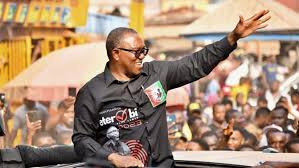

The Obidient Movement Worldwide has firmly ruled out any possibility of former Anambra State Governor Peter Obi accepting a vice-presidential slot ahead of the 2027 general election, insisting that the former Labour Party presidential candidate remains focused solely on contesting for the nation’s top office. The clarification was made by the group’s National Coordinator, Dr Yunusa Tanko, amid growing political speculation that Obi could emerge as a potential running mate to former Vice President Atiku Abubakar as opposition figures explore alliance options ahead of the polls. Tanko’s comments were aimed at dispelling what he described as persistent misinformation surrounding Obi’s political intentions.
Speaking in an exclusive interview, Tanko stated unequivocally that Obi has no interest in serving as a vice president under any political arrangement. According to him, the Obidient Movement has never discussed such an option internally, nor has Obi given any indication that he would consider it. “We have never put that on the table. Obi is running for the office of the President of the Federal Republic of Nigeria. No more, no less,” Tanko said, adding that the movement had already issued a public statement to that effect. He stressed that the group’s position remains unchanged despite ongoing conversations within opposition circles.
Tanko explained that the renewed speculation was largely fueled by Obi’s recent political moves, particularly his defection from the Labour Party to the African Democratic Congress (ADC). Last Wednesday, Obi formally joined the ADC at a well-attended event held at the Nike Lake Resort in Enugu State, marking a significant shift in his political strategy ahead of 2027. During the event, Obi called on Nigerians and opposition forces to unite under what he described as a broad national coalition aimed at rescuing the country from poverty, deepening disunity, and democratic decline.
In his remarks at the Enugu event, Obi sharply criticised the current administration, accusing it of mismanaging Nigeria’s economic and social challenges. He argued that worsening living conditions, rising insecurity, and declining public trust in governance underscored the need for a new leadership approach rooted in accountability, competence, and compassion. His comments resonated with supporters who view him as a symbol of reform and fiscal discipline, while also intensifying debates about how the opposition can best position itself to challenge the ruling party in 2027.
The debate over Obi’s political future has also spilled into the public arena, drawing in prominent figures within the ADC and the broader opposition movement. A notable exchange emerged between ADC chieftain and publisher Dele Momodu and political economist Professor Pat Utomi, both of whom have expressed strong but differing views on Obi’s path to the presidency. The exchange highlighted underlying tensions between idealism and pragmatism in opposition politics, particularly around coalition-building and ticket negotiations.
Professor Utomi had warned that he would withdraw his support for Obi if the former governor agreed to serve as a vice-presidential candidate in any emerging opposition coalition. His position was rooted in the belief that Obi’s political momentum and reformist appeal would be undermined by playing a secondary role. Utomi’s comments, however, drew a sharp response from Momodu, who questioned what he described as rigid thinking in a complex political environment.
Reacting on his verified X account, Momodu argued that insisting Obi must not run behind anyone ignored the realities of Nigerian politics. He contended that coalition-building often requires compromise and strategic flexibility rather than ideological purity. “Anyone insisting that Obi cannot run behind anyone is definitely not a Democrat who wishes to rescue Nigeria from one-man dictatorship,” Momodu wrote, while acknowledging his respect for Utomi’s intellect and contributions to public discourse.
Momodu further argued that electoral success in Nigeria is shaped by factors beyond intellectual brilliance or policy depth, including voter sentiment, regional dynamics, and political structures. He cited past elections to support his point, noting that political parties often prioritise candidates with broader electoral appeal. Referring to the 2023 election, he observed that despite having a widely respected intellectual figure like Yemi Osinbajo, the All Progressives Congress ultimately chose Bola Ahmed Tinubu as its presidential candidate, describing the decision as a reflection of political “reality.”
Highlighting Obi’s political journey, Momodu recalled that Atiku Abubakar had previously elevated Obi to the national stage by selecting him as his running mate in the 2019 presidential election, despite opposition from some party stakeholders. He urged Obi to remain committed to the ADC, describing loyalty and humility within party structures as essential qualities for any serious presidential aspirant. According to Momodu, navigating Nigeria’s political terrain requires not only vision but also patience and strategic alliances.
As discussions around 2027 continue to evolve, Tanko’s intervention appears aimed at reaffirming the Obidient Movement’s core message and maintaining clarity among its supporters. While debates over strategy, coalitions, and electoral realism persist within the opposition, the movement insists that Obi’s ambition remains unchanged. With the general election still two years away, the unfolding exchanges underscore both the opportunities and challenges facing opposition forces as they attempt to balance principle, pragmatism, and the quest for electoral victory.