

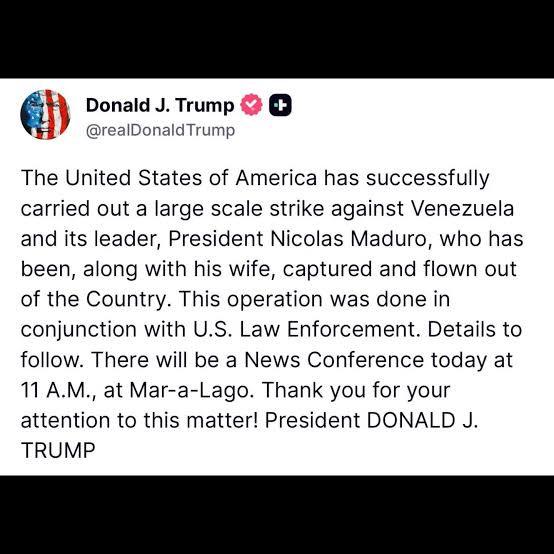

In the early hours of 3 January 2026, the United States announced a dramatic military operation in Venezuela, saying it had struck multiple sites and taken Venezuelan President Nicolás Maduro and his wife, Cilia Flores, into custody. President Donald Trump and senior U.S. officials publicly confirmed the operation, framing it as a decisive response to longstanding accusations of criminal activity and state behaviour they deem dangerous to U.S. interests.
According to the U.S. government, Maduro and Flores were captured after a coordinated assault involving air strikes and special forces units. Photos released by the White House show Maduro aboard a U.S. Navy vessel, while Trump described the mission as a significant moment in the United States’ efforts to enforce accountability for alleged “narco-terrorism” and drug trafficking ties.
U.S. officials have said Maduro will face prosecution in American courts. Earlier legal indictments accused him of narco-terrorism and other serious crimes — charges that have formed the basis of U.S. sanctions and a bounty campaign increasing the reward for information leading to his arrest. Secretary of State and White House statements indicated that Washington intends to oversee Venezuela’s governance transition, although details about Maduro’s legal process or location remain limited.
Venezuelan Government and Regional Response
The Venezuelan government has sharply rejected the U.S. narrative. Senior officials and state-run media describe the operation as a “military aggression” and an unlawful violation of Venezuela’s sovereignty, with official statements condemning the assault as a breach of the United Nations Charter and a threat to regional stability. Caracas has called on the international community to denounce the actions and defend the nation’s independence.
Opposition figures in Venezuela have offered a contrasting reaction. Some, such as opposition leader María Corina Machado, praised the capture as a turning point that could pave the way for democratic transition and the rebuilding of institutions. Machado described the event as the “hour of freedom” and expressed readiness to form a transitional government recognized by Washington.
International Reaction and Geopolitical Tension
Global responses to the U.S. operation have been varied and highly charged. Many Latin American governments and regional blocs strongly criticised the intervention as a dangerous precedent that undermines state sovereignty and could destabilise the region. Leaders in Brazil, Mexico and other nations emphasised diplomatic solutions and respect for international law.
China and Russia also condemned the action, decrying it as a breach of international norms and a form of unilateral aggression that threatens peace and security in the Caribbean and Latin America. Conversely, some political figures in the United States and allied countries supported the operation, citing concerns about corruption, criminal networks, and Venezuela’s political legitimacy.
Legal and Normative Debates
Legal experts have raised questions about the basis for the U.S. operation. Under the United Nations Charter, the use of force against a sovereign state generally requires either Security Council approval or a clear case of self-defense, neither of which has been formally communicated in this instance. Several international law scholars argue that absent explicit UN authorization, such actions may constitute violations of international legal norms. Critics emphasise that diplomatic, legal and multilateral pressure are customary mechanisms for addressing transnational crime and governance concerns — rather than unilateral military intervention.
Regional Security and Humanitarian Concerns
Beyond legal debates, the situation has triggered concerns about regional security, potential refugee flows and the humanitarian conditions inside Venezuela. Caracas reported continued state resistance and public dismay, while neighbouring Colombia deployed additional security personnel to its border amid expectations of refugee movements. Venezuelan forces and militias loyal to the ousted government have not formally surrendered, raising questions about stability on the ground.
What Happens Next?
The aftermath of the operation is highly uncertain:
- Governance: Washington has indicated involvement in Venezuela’s transition, but the structure, timeline and legitimacy of that process are unclear.
- Legal Proceedings: If Maduro is brought to the U.S. for trial, questions remain over jurisdiction, fair trial protocols, and international judicial cooperation.
- Diplomacy: International actors, including the United Nations and regional bodies such as the Organization of American States (OAS), are expected to play roles in mediating responses and potential negotiations.
What is undisputed is that this episode represents one of the most consequential foreign policy events in recent Western Hemisphere history — reshaping U.S.–Latin America relations, stirring global legal debate, and ushering in a period of diplomatic turbulence with far-reaching consequences.