

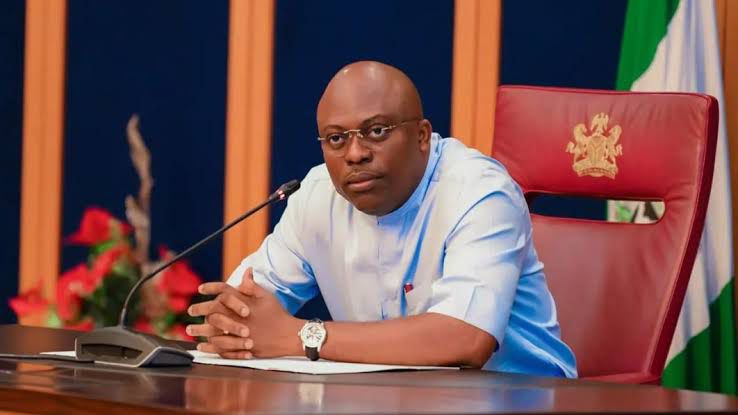

Rivers State’s political landscape plunged into fresh turmoil on Thursday after a key faction of the Peoples Democratic Party (PDP) publicly accused Governor Siminalayi Fubara of betrayal and abandoning the party’s mandate following his defection to the All Progressives Congress (APC). The allegations were made during a press briefing in Port Harcourt by Dr Nname Ewor, a factional caretaker chairman of the PDP in the oil-rich southern state.
Fubara’s former party accused him of misleading party stakeholders and abandoning efforts to resolve an internal political crisis, which at one point led to a federal state of emergency being imposed. At Thursday’s press conference, Ewor delivered a detailed critique of Fubara’s conduct in recent months, portraying it as a betrayal of both the PDP and the people of Rivers. According to Ewor, Fubara had led party members to believe he could counter the influence of Nyesom Wike, the powerful Minister of the Federal Capital Territory and former governor of Rivers, only to switch allegiance to the APC at a crucial political juncture.
“While this disagreement with the Rivers lawmakers was on, a lot of us were deceived into believing so many things that were not true. In other words, the governor deceived us,” Ewor told reporters. He said many PDP leaders were led by “propaganda and lies” into expecting that Fubara would wrest political control from Wike, a narrative that has sharply divided elite circles in the state. 
The roots of the controversy trace back to early disagreements between Fubara and members of the Rivers State House of Assembly shortly after he assumed office, a dispute that escalated into a full-blown political crisis. The standoff reportedly included the bombing of the Assembly complex and prompted President Bola Ahmed Tinubu to intervene by declaring a state of emergency in the state in 2025 — a rare and extraordinary federal action that further polarized political factions. 
Ewor alleged that part of the peace agreements brokered during the emergency rule included commitments by Fubara not to seek re-election, the reinstatement of traditional leadership structures, and changes in key administrative staff — terms he says were never honoured by the governor. He also accused Fubara of entering into undisclosed agreements with President Tinubu shortly before the federal government lifted the emergency rule, circumstances that ultimately preceded his defection to the APC. 
Following his defection, Fubara has been heard boasting that Tinubu would compel lawmakers to pass the 2026 state budget and might even influence Wike’s support for his prospective re-election bid, claims that Ewor used to question the governor’s broader motives and loyalty.
In his remarks, Ewor stressed that Fubara owed Rivers residents and Nigerians at large a full account of the “agreements reached with the FCT minister and the state house of assembly” under the federal government’s mediation. He insisted that the governor’s actions directly impact the people whose votes put him in office.
Ewor’s faction also challenged Fubara’s absence from the PDP’s national convention held in Ibadan in late 2025, pointing to his failure to attend as an early indicator of disloyalty. The national convention saw the dissolution of the Rivers State PDP executive committee and the appointment of a caretaker panel, of which Ewor became chairman. 
Despite the bitter criticism, Ewor expressed support for President Tinubu’s re-election bid in 2027.
Samuel Aina