

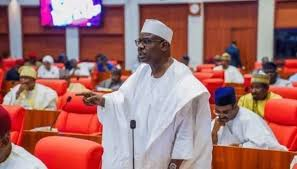

Former Senate Leader and Senator representing Borno South, Ali Ndume, has called on the Federal Government to extend ongoing joint military operations with the United States against terrorist hideouts to Nigeria’s North-East, citing the continued presence and resilience of Boko Haram and the Islamic State West Africa Province (ISWAP) in the region. Ndume made the appeal in a statement issued on Saturday, in which he commended recent US-backed airstrikes targeting suspected ISWAP cells in Tangaza Local Government Area of Sokoto State and urged that similar actions be replicated in the North-East to further degrade insurgent capacity.
The lawmaker described the reported airstrikes in Sokoto as a positive development in Nigeria’s counter-terrorism efforts, noting that cooperation between Nigerian forces and international partners could yield significant results if strategically expanded. He argued that while the North-West has increasingly drawn attention due to banditry and insurgent infiltration, the North-East remains the historical epicentre of jihadist violence and should remain a priority in coordinated military operations.
Ndume identified Lake Chad, the Mandara Mountains, and Sambisa Forest as three major insurgent enclaves where Boko Haram and ISWAP continue to operate, recruit, and regroup despite years of military campaigns. According to him, these areas have long served as strongholds for the groups, providing difficult terrain and cross-border access that complicate counter-insurgency operations by Nigerian forces acting alone.
He urged that the scope of the existing Nigeria–United States military cooperation be broadened beyond airstrikes to include enhanced ground troop training, intelligence sharing, logistics support, and the deployment of attack helicopters to back Nigerian forces during offensive operations. Ndume said such comprehensive collaboration would significantly weaken the operational capabilities of insurgent groups and improve the effectiveness of troops on the ground.
The former Chairman of the Senate Committee on Army also commended President Bola Ahmed Tinubu for what he described as the highest budgetary allocation to the defence sector in the proposed 2026 budget. However, he stressed that increased funding must be matched with accountability and transparency to ensure that resources are efficiently deployed to address Nigeria’s persistent security challenges.
Reacting to the recent suicide bomb attack on a mosque in Gamboru, Maiduguri, the Borno State capital, Ndume expressed sympathy for the victims and their families, noting that the incident reportedly claimed at least five lives and left several others injured. He described the attack as a stark reminder that insurgent violence continues to pose a grave threat to civilians, even in areas with heavy military presence.
Ndume rejected narratives that frame terrorist violence in Nigeria as religiously motivated, stressing that insurgents target Nigerians irrespective of faith. He noted that the victims of the Gamboru mosque attack were Muslims and said the incident underscored the fact that Boko Haram and ISWAP are driven by extremist ideology rather than genuine religious concerns.
According to the senator, the persistence of such attacks highlights the need for sustained and coordinated military pressure on insurgent groups, particularly in their known enclaves. He argued that without decisive action in these areas, terrorists would continue to stage attacks on soft targets and undermine public confidence in security efforts.
Ndume’s remarks come amid renewed international attention on Nigeria’s security situation following confirmation by United States President Donald Trump that American forces carried out airstrikes against suspected terrorist elements in Nigeria. The confirmation marked a rare public acknowledgment of direct US military action on Nigerian soil.
US officials said the operation in Sokoto State was conducted based on shared intelligence and in coordination with Nigerian authorities as part of ongoing efforts to degrade extremist groups operating in the country. They added that the strikes were aimed at disrupting militant networks and preventing further attacks, though details on casualties and operational outcomes were limited.
Nigeria’s Minister of Foreign Affairs, Yusuf Maitama Tuggar, also confirmed that Nigeria provided the intelligence that led to the strike and formally approved the operation before it was executed. Tuggar said the cooperation reflected Nigeria’s sovereign decision to work with international partners to address evolving security threats.
Nigeria has faced multiple security crises for more than a decade, most notably the Boko Haram insurgency that began in the North-East in 2009 and later splintered into rival factions, including ISWAP. The conflict has resulted in tens of thousands of deaths and the displacement of millions of people across the region.
In addition to the insurgency in the North-East, Nigeria has grappled with widespread banditry, kidnapping, and criminal violence in the North-West, further stretching the capacity of security forces. Analysts say the convergence of these threats has complicated Nigeria’s security landscape and increased calls for both domestic reforms and international assistance.
While the United States has long supported Nigeria through intelligence sharing, training, and military aid, direct US airstrikes in Nigeria are rare and often attract public scrutiny due to concerns about sovereignty and the rules governing foreign military involvement. Past operations have typically been conducted discreetly, with limited public disclosure.
In a separate reaction, the African Democratic Congress (ADC) weighed in on the US Africa Command (AFRICOM) airstrikes in Sokoto State, raising concerns about Nigeria’s reliance on foreign military action. The party’s spokesperson, Bolaji Abdullahi, criticised the Tinubu administration, arguing that national security is a core constitutional responsibility that should not be outsourced.
In a statement posted on X, Abdullahi said while the ADC recognises the serious security challenges confronting Nigeria and supports lawful and effective measures to save lives, it opposes sustained physical operations by foreign military forces on Nigerian soil. He warned that desperation should not lead Nigeria to compromise its sovereignty.
The ADC said it accepted the AFRICOM airstrikes in Sokoto only as a last-resort measure, stressing that such actions must not substitute for Nigeria-led security operations. The party attributed the situation to what it described as administrative failings in addressing the country’s security challenges.
The party also criticised the manner in which information about the strike was communicated to Nigerians, noting that confirmation first came from the US President rather than a direct address by Nigerian authorities. It described this as troubling and reflective of inadequate appreciation of the sensitivity of foreign military action within Nigeria.
The ADC concluded by calling on the Federal Government to be transparent about the outcomes of the operation, including the number of terrorists reportedly killed, and urged clearer communication with the public. As debate continues, Ndume’s call and the ADC’s response highlight the broader national conversation on how Nigeria should balance international cooperation, sovereignty, and domestic capacity in confronting its deepening security challenges.