

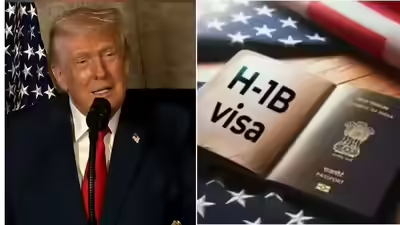

A US federal judge on Tuesday upheld President Donald Trump’s controversial $100,000 fee for processing H‑1B visa applications, a decision that could reshape the United States’ skilled-worker immigration landscape. US District Judge Beryl Howell wrote in a 56-page opinion that, while the fee could “inflict significant harm on American businesses and institutions of higher education,” the president has “broad statutory authority” to address what he perceives as matters of economic and national security.
The fee, which was announced in September and took effect with just 36 hours’ notice, triggered immediate confusion among US companies trying to understand how it would work and who would be affected. Previously, H‑1B petition fees typically ranged from about $2,000 to $5,000, meaning the new $100,000 charge represents a dramatic increase designed to curb perceived abuses of the immigration system.
The H‑1B visa programme allows US employers to hire foreign workers in specialised fields, particularly in technology and other high-skilled sectors. Each year, the programme issues 65,000 visas, with an additional 20,000 reserved for workers holding advanced degrees. Typically, H‑1B visas are valid for three to six years.
Prior to President Trump’s order, application fees for H‑1B visas generally ranged between $2,000 and $5,000, depending on specific circumstances. Under the new directive, however, the fee for new H‑1B applications jumps sharply to $100,000, representing a dramatic increase designed to curb perceived abuses of the system.
H‑1B visas are awarded through a lottery system, although the programme primarily serves the US technology sector. In parallel, the US Department of Homeland Security has sought to overhaul the selection process, proposing a system that prioritises higher-paid and more highly skilled foreign workers. The administration maintains that these changes are intended to protect American wages and jobs.
Trump has defended the hefty fee as necessary to protect American workers and discourage companies from misusing the programme, arguing that it will encourage employers to hire domestic talent. However, industry leaders, including influential tech entrepreneurs, warned that such a high fee could exacerbate domestic talent shortages in sectors like information technology, research, and engineering.
Major companies that rely heavily on H‑1B visas include Amazon, Tata Consultancy Services (TCS), Microsoft, Meta Platforms, and Apple. Critics argue that the steep fee could force employers to either absorb significantly higher labour costs or reduce the number of highly skilled foreign hires, potentially impacting innovation and competitiveness in key industries.
The legal challenge to the fee was brought by the US Chamber of Commerce, a pro-business lobbying group, and the Association of American Universities, which argued that the fee could undermine innovation and impede the ability of firms and academic institutions to attract needed global talent. The Chamber, which is generally regarded as Republican-friendly, has been a vocal critic of the fee and its potential economic impact.
Judge Howell’s ruling noted the potential for economic harm but ultimately affirmed that the president has the authority to implement the fee under existing statutes. The decision underscores the judiciary’s recognition of executive discretion in matters that intersect economic and national security concerns, even when private entities may be adversely affected.
At least two additional lawsuits challenging the $100,000 H‑1B visa fee remain ongoing, indicating that the policy’s legality and broader implications may continue to face scrutiny in the courts. These cases could shape how the fee is applied and whether modifications will be required to balance executive authority with economic and academic interests.
The H‑1B programme itself has deep roots in US immigration policy, having been created in 1990 to allow employers to hire foreign professionals in specialty occupations requiring at least a bachelor’s degree or equivalent. Technology companies, universities, and consulting firms have long relied on the programme to fill roles they argue are difficult to staff domestically.
Under the traditional system, 85,000 H‑1B visas are awarded annually through a lottery mechanism, with roughly three-quarters of successful applicants hailing from India, followed by workers from countries such as China and Canada. Over time, the programme became a pillar of the US tech economy, but also a flash point in debates over immigration, wages, and labor market policy.
In addition to business opposition, separate legal challenges have been filed by Democratic-led states and coalitions of employers, nonprofits, and religious organizations, questioning the legality and economic impact of the fee. Trump cited his authority under federal immigration law to justify the order, asserting that he has the power to restrict the entry of foreign nationals deemed detrimental to US interests.
Judge Howell noted that the administration had adequately supported its claim that the H‑1B programme was being used in ways that displaced American workers, citing instances where companies laid off thousands of US employees while continuing to petition for H‑1B visas.
As the legal battles continue, US businesses and educational institutions must navigate the financial and operational impact of the new fee. While Trump and his administration argue the measure protects American workers, critics warn that the fee may constrain innovation, limit access to top talent, and complicate planning for companies and universities that rely on the H‑1B program to fill specialized positions.