

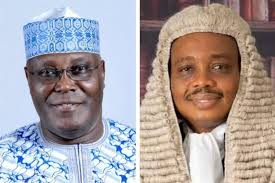

The Nigerian Bar Association (NBA) and former Vice President Atiku Abubakar have raised serious concerns over alleged post-legislative alterations to the recently enacted Tax Reform Acts, urging the Federal Government to immediately suspend their implementation. Both the NBA and Atiku warned that the alleged changes threaten the integrity, transparency, and credibility of Nigeria’s legislative process.
In a statement on Tuesday, NBA President Mazi Afam Osigwe (SAN) said the controversies surrounding the laws strike at the core of constitutional governance and called for a comprehensive, open, and transparent investigation to restore public confidence. “The Nigerian Bar Association considers it imperative that a comprehensive, open, and transparent investigation be conducted to clarify the circumstances surrounding the enactment of the laws and to restore public confidence in the legislative process. Until these issues are fully examined and resolved, all plans for the implementation of the Tax Reform Acts should be immediately suspended,” Osigwe said.
The NBA also warned that legal and policy uncertainty arising from the controversy could unsettle the business environment, erode investor confidence, and create unpredictability for individuals, businesses, and institutions expected to comply with the new tax laws. The association urged relevant authorities to act swiftly to prevent potential economic disruptions.
Former Vice President Atiku Abubakar described the alleged post-legislative alterations as a “grave assault on legislative supremacy” and accused the executive of inserting coercive enforcement powers, imposing harsher financial obligations on citizens, and removing key accountability mechanisms without parliamentary approval.
According to Atiku, the changes reportedly inserted into the tax laws include granting tax authorities arrest powers, allowing property seizure and garnishment without court orders, and permitting enforcement sales without judicial oversight. “This draconian overreach by the executive branch undermines the foundational principle of legislative supremacy in the making of laws. It reveals a government more interested in extracting wealth from struggling citizens than empowering them to prosper,” Atiku said.
The controversy emerged after a Sokoto lawmaker in the House of Representatives, Abdussamad Dasuki, raised alarms over discrepancies between the final copy of the tax laws passed by the National Assembly and the version officially gazetted by the Federal Government. Dasuki alleged that the gazetted version contained significant alterations not approved by lawmakers.
In response to Dasuki’s concerns, the House of Representatives last Thursday constituted a seven-member panel to investigate the alleged irregularities and report its findings to the legislature. The panel is expected to clarify the nature of the discrepancies and recommend corrective action.
Atiku further called on the judiciary, civil society groups, and the Economic and Financial Crimes Commission (EFCC) to investigate the alleged illegal amendments, strike down unconstitutional provisions, and prosecute those responsible. He warned that the alterations could create financial obstacles, making it difficult for ordinary Nigerians to contest unfair assessments and increasing compliance costs for businesses operating in a challenging economic climate.
He also highlighted the removal of accountability mechanisms, deletion of quarterly and annual reporting obligations to the National Assembly, elimination of strategic planning submission requirements, and removal of ministerial supervisory provisions. Atiku argued that these actions insulated the government from oversight while expanding its powers.
“The constitutional violation exposes a troubling reality: a government obsessed with imposing ever-increasing tax burdens on impoverished Nigerians rather than creating conditions for prosperity. Instead of investing in infrastructure, education, healthcare, and economic empowerment, this administration chooses the path of aggressive extraction from an already struggling populace,” Atiku said.
Atiku warned that no law can take effect if it was not properly passed by the National Assembly, stressing that upholding this principle is critical to preventing a slide into arbitrary governance where constitutional protections are rendered meaningless.
In a separate development, the Executive Chairman of the Akwa Ibom State Revenue Service, Mr. Okon Okon, addressed public concerns, clarifying that citizens will still be able to access their bank accounts without a Tax Identification Number (TIN) from January 1, 2026. He described misinformation regarding account restrictions as false.
Okon added that money in personal accounts would not be taxed and announced that the Joint Tax Board has launched a website enabling citizens to generate TINs in 20 seconds using their National Identification Number (NIN) and date of birth. He said the reforms aim to reduce multiple taxation, simplify the system, and relieve Nigerians of undue tax burdens.
He further explained that the reforms reduce the number of different taxes across the federal, state, and local levels from 63 to about 10, with clear delineation of which tier collects each tax. Okon praised Governor Umo Eno of Akwa Ibom for supporting public sensitisation and emphasised that the reforms are intended to boost economic activity, enhance development, and reduce interference from non-state actors.
The NBA and Atiku have both urged the National Assembly to expedite its investigation, rectify any illegal alterations, and hold responsible parties accountable, stressing that transparent and lawful enforcement of tax laws is essential to preserving public trust, protecting citizens’ rights, and ensuring a stable business environment.