

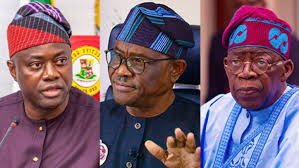

Oyo State Governor, Seyi Makinde, has publicly detailed the circumstances that led to his fallout with the Minister of the Federal Capital Territory, Nyesom Wike, saying the rift was triggered by what he described as a shocking political pledge by the former Rivers State governor to “hold down” the Peoples Democratic Party (PDP) for President Bola Tinubu’s re-election bid in 2027.
Makinde made the disclosure on Tuesday during a media chat in Ibadan, the Oyo State capital, where he said the relationship between him and Wike collapsed after a meeting involving President Tinubu, the President’s Chief of Staff, Wike and two other individuals. According to the governor, Wike made the declaration in the President’s presence without any prompting or endorsement from Tinubu.
“The real issue was that I was in a meeting with the President. Wike, the President’s Chief of Staff and two others were also at that meeting. And Wike said to the President, ‘I will hold the PDP for you against 2027,’” Makinde said. “I was in shock,” he added, recounting his reaction to what he described as an unsolicited pledge that ran contrary to the interests of the opposition party.
Makinde said he confronted Wike shortly after the meeting, questioning whether such a commitment had ever been discussed or agreed upon. “So we got to the veranda, and I said, ‘Wike, did we agree to this?’” the governor stated, explaining that while Wike was entitled to support Tinubu personally, he should not obstruct others who wished to keep the PDP viable as an opposition platform.
He said the core of the disagreement lay in what he described as an attempt to weaken the PDP and undermine democratic competition. “The real issue is that Wike would like to support the President for 2027 – that is fine; it is within his right to do that. But also some of us who want to ensure that democracy survive and we don’t drift into a one-party state, and we want to ensure that the PDP survive, he should also allow us to do our own thing,” Makinde said.
Providing further context, Makinde said efforts were made to persuade Wike to reconsider his stance, especially after it became clear that President Tinubu did not ask for such a pledge. “After that meeting, I kept thinking, the President did not ask him to do it; he was the one who volunteered to do that. So when I was telling our mutual friend, I said maybe he was talking about an errand the President never sent him,” he said.
The Oyo State governor said Wike remained unmoved despite attempts at engagement, prompting him to take a firm position against supporting Tinubu in the next presidential election. “So I said now is the time to confront him because I told him, from that day, I will never be a part of this, and that is why I will not support the President for 2027,” Makinde said, adding that political choices must remain a matter of individual conviction.
Makinde also disclosed that he regretted his decision to support Tinubu during the 2023 presidential election. “I regret supporting Tinubu in the 2023 election. I am not above mistakes,” he said, while insisting that his position was guided by concern for democratic balance rather than personal animosity.
The governor warned that moves perceived as pushing Nigeria toward a one-party system could have serious consequences for governance and stability. “If you move the country towards a one-party state, what happens when you need a bipartisan approach to issues? Who are you going to call?” he asked. He further cautioned that history offered lessons on the dangers of political exclusion. “The day you move the country towards a one-party state, you remember what happened with the Arab Spring. Once people don’t have leadership, they will find leadership by all means.”
Makinde said public frustration was already growing across the country and warned of potential unrest if political pluralism was undermined. “What Nigerians would show politicians and elites in 2027, we cannot imagine right now,” he said, linking economic hardship, hunger and rising public anger to the need for a strong and credible opposition.
The governor’s comments come against the backdrop of the role played by the so-called G-5 governors ahead of the 2023 general election. Makinde and Wike were key members of the group of five PDP governors who opposed the party’s presidential ticket, arguing that the selection of Atiku Abubakar as candidate and Iyorchia Ayu as national chairman, both from the North, violated the principle of zoning.
Beyond national politics, Makinde also addressed internal challenges within the PDP, accusing the Independent National Electoral Commission (INEC) of acting in a one-sided manner in handling the party’s leadership crisis. He insisted there was no faction within the PDP and maintained that the party’s convention held in Ibadan was valid and conducted in line with the law. “We held a convention in Ibadan. We gave adequate notice to INEC, which is what we are required to do under the law,” he said.
On speculation about his own political future, Makinde said he possessed the qualifications to aspire to the presidency if he chose to do so. “To serve this country at the highest level, I am qualified,” he said, citing his two terms as governor and his background in the oil and gas sector, where he said he ran a successful engineering company and earned his first million dollars from a contract in 1997.
Makinde also addressed local governance issues, accusing the Federal Government of what he termed “double speak” on local government autonomy and arguing that dialogue would be required to resolve challenges surrounding the implementation of the Supreme Court judgment on the matter. He further dismissed allegations of land grabbing linked to the Ibadan Circular Road project, saying the 500-metre corridor was gazetted in 2018 before his administration assumed office.
According to him, compensation was being paid to affected residents, including those without formal land documentation, provided they could show proof of residence. He said his administration was focused on building strong institutions rather than pursuing infrastructure projects without lasting impact. “Infrastructure alone does not guarantee a legacy unless it is embedded in strong institutions,” Makinde said.
Wike’s camp responded sharply to Makinde’s comments, with the minister’s media aide, Lere Olayinka, accusing the Oyo State governor of selfishness and political opportunism. In a post on his official X handle, Olayinka alleged that Makinde lacked loyalty to any individual or political party and was driven solely by personal ambition.
Olayinka claimed Makinde’s political history showed a pattern of defection whenever his ambitions were threatened. He alleged that Makinde left the PDP for the All Nigeria Peoples Party in 2007 after failing to secure a senatorial ticket, moved to the Social Democratic Party in 2015 after missing out on the governorship ticket, and would have defected again in 2019 if he had not secured the PDP ticket.
He further alleged that Makinde joined the G-5 governors in 2023 primarily to secure his re-election and accused him of working against Osun State Governor Ademola Adeleke during the 2022 governorship election to remain the only PDP governor in the South-West. “He is Governor Seyi Makinde, and surely, after 2027, he will be in another party,” Olayinka wrote.
Meanwhile, the deepening crisis within the PDP has been compounded by INEC’s refusal to recognise the Tanimu Turaki (SAN)-led National Working Committee, citing subsisting court judgments and unresolved legal processes. The commission said it could not update or recognise the list of national officers allegedly elected at the party’s November convention in Ibadan.
In a letter dated December 22 and signed by the Secretary to the Commission, Dr Rose Oriaran-Anthony, INEC said there were two subsisting final judgments of the Federal High Court in Abuja restraining it from recognising or accepting the outcome of the PDP national convention pending compliance with court orders. The commission noted that the filing of appeals did not operate as a stay of execution.
INEC also referenced interim orders from a High Court in Oyo State but stated that such orders could not override existing final judgments of courts of equal or higher authority. The commission said it remained bound to obey the court decisions in line with the Constitution.
Reacting, the Turaki-led NWC, through its National Publicity Secretary, Ini Ememobong, insisted that the party leadership was legitimate and maintained that there was no faction within the PDP. However, Senator Samuel Anyanwu, National Secretary of the Wike-backed faction, welcomed INEC’s decision, describing it as a faithful adherence to court judgments.
The dispute has left both factions laying claim to the party’s leadership, with PDP governors endorsing the Ibadan convention while the Wike-aligned group insists it remains in control through a caretaker committee. As the legal and political battles continue, the crisis has underscored deep divisions within the opposition party ahead of the 2027 general election.