

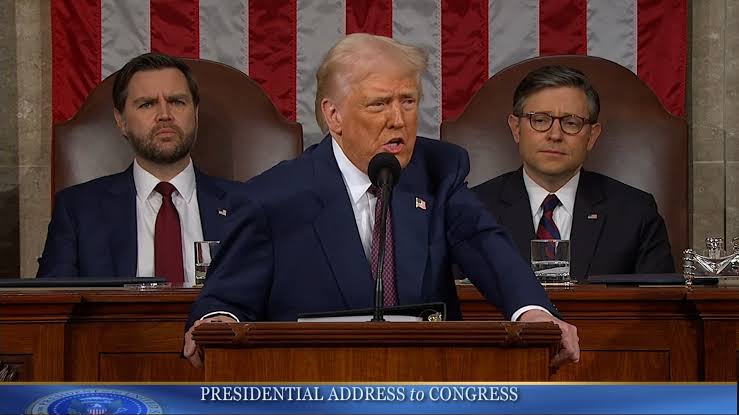

On 18 December 2025, U.S. President Donald J. Trump delivered his annual State of the Nation address before a joint session of Congress, outlining his administration’s priorities as the United States heads into a crucial election year and a period of significant global geopolitical tension. The speech — watched closely by policymakers, business leaders, and international partners — blended domestic policy initiatives with broader strategic messaging on national security, economic competitiveness, and social issues.
Trump’s address was marked by a focus on economic nationalism and domestic resilience. He reiterated his commitment to strengthening the U.S. economy through regulatory reform, tax stability, and a continuation of policies aimed at boosting American manufacturing. “Our economy will remain the engine of the free world,” Trump declared, pointing to strong employment figures and resilient gross domestic product growth as evidence that his priorities are delivering results. The president emphasised that future growth should not be dictated by overseas market fluctuations, but by American innovation and productivity.
A major part of Trump’s domestic agenda centred on immigration and border security. In a section of the speech that drew both applause and criticism, he called for enhanced border enforcement measures, including expanded use of technology, increased support for border patrol capacity, and more stringent asylum screening processes. Trump positioned these moves as necessary for national security and for protecting American workers from unfair labor competition. Critics, including civil liberties advocates, challenged the framing as overly punitive, but Trump’s supporters praised the emphasis on order and sovereignty.
The president also spent considerable time on energy independence and environmental policy. Trump underscored his belief that energy policy must prioritise economic growth and U.S. strategic advantage. He defended recent actions to expand domestic energy production — including oil and natural gas — while also acknowledging the growing economic role of emerging technologies such as advanced nuclear, hydrogen, and carbon capture. He framed energy policy as a bridge between environmental responsibility and economic competitiveness, hinting at future initiatives to attract investment in clean technologies without compromising energy security.
Internationally, Trump’s address touched on global alliances and strategic competition. He refocused attention on China as a competitor, pledging to hold Beijing accountable on trade practices, intellectual property rights, and unfair economic behavior. At the same time, he asserted that cooperation with China on global issues such as climate change and pandemic preparedness remained possible if grounded in reciprocity and respect. On Europe, Trump reaffirmed U.S. commitments to traditional alliances while urging NATO partners to increase defence spending. He portrayed the U.S. as a leader willing to engage but also demanding fair burden-sharing.
A central thread in the address was technology and national competitiveness. Trump highlighted artificial intelligence, semiconductors, biotechnology, and space exploration as strategic arenas where American leadership is essential. He proposed expanded federal support for research and development, incentives for private-sector innovation, and regulatory frameworks designed to keep the U.S. at the forefront of global technological advancement. The administration’s recent actions to ease AI export restrictions — particularly those affecting key hardware exports to China — were cited as examples of balancing competitiveness with national interest.
While largely optimistic in tone, the speech acknowledged real challenges. Trump pointed to inflationary pressures, supply-chain bottlenecks, and workforce shortages as areas requiring sustained executive and legislative attention. To tackle these, he called for cooperation across party lines to advance infrastructure, education, and workforce development initiatives.
Reactions to the address were predictably divided along political lines. Supporters praised Trump’s emphasis on economic strength, security, and American exceptionalism. Critics argued the speech leaned too heavily on nationalist rhetoric and lacked substantive detail on issues such as healthcare, climate action, and social equity. International observers noted its firm posture on strategic competition, especially regarding China and technology leadership, which could signal an intensification of U.S. foreign policy priorities in 2026.
In conclusion, President Trump’s State of the Nation address offered a broad vision of economic resilience, technological leadership, and national sovereignty. As the U.S. prepares for pivotal elections and continued global realignment, the speech set a clear marker for the administration’s agenda — one that seeks to balance domestic priorities with an assertive global stance. Whether the address translates into substantive bipartisan progress remains to be seen, but its themes will undoubtedly shape political and economic discourse in the months to come.