

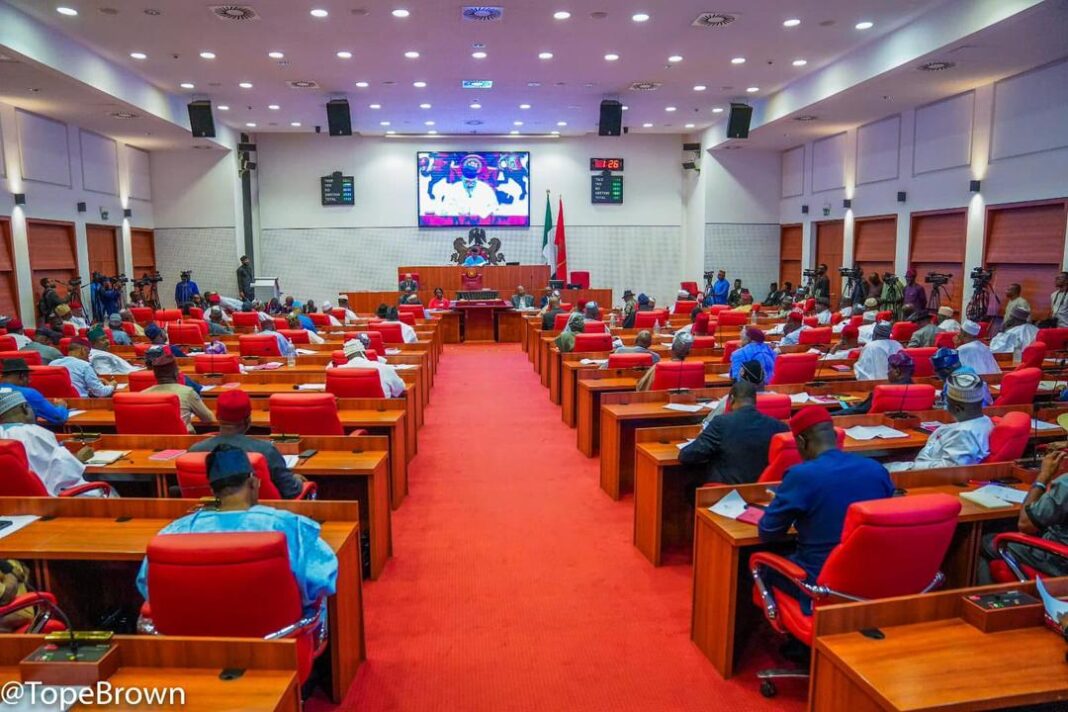

The screening of ambassadorial nominees at the Senate turned dramatic when one of President Bola Tinubu’s candidates, Emmanuel Adeyemi, failed to name all three senators representing his home state of Ekiti. What began as a routine interaction between the nominee and the Senate Committee on Foreign Affairs quickly escalated into an embarrassing spectacle that has now become a major talking point on social media.
The incident occurred during the ongoing confirmation exercise for the sixty-five ambassadorial nominees sent to the Senate by the President. Adeyemi, a deputy director in the Office of the Permanent Secretary at the Ministry of Foreign Affairs and one of three nominees from Ekiti State, had arrived with an impressive academic profile. He holds a doctorate and has worked in Hong Kong and France. His qualifications initially impressed several lawmakers who saw him as someone who could make a credible representation for Nigeria abroad. However, the situation shifted when he was asked a standard courtesy question to name the senators from his state. The nominee began by correctly naming two people, Opeyemi Bamidele and Yemi Adaramodu. When the third name was expected, he froze.
The silence in the room quickly became uncomfortable, and the moment worsened when a companion seated behind him pulled out a phone and began searching online for the answer. The third senator from the state is Cyril Fasuyi, but the nominee’s team had to look it up online. The committee members were visibly displeased. Senator Asuquo Ekpenyong from Cross River South expressed disappointment and said it reflected a worrying level of unpreparedness. He stressed that anyone nominated to represent Nigeria abroad should at least possess basic knowledge of their home state’s representation.
His view received support from other lawmakers, including Adams Oshiomhole and Seriake Dickson, who agreed that such a lapse raised questions about the rigour behind the nomination process. Amid the tension, Senator Yunus Akintunde, who stood in for Senate Leader Opeyemi Bamidele, appealed to his colleagues to show leniency. He said the committee should not judge the nominee too harshly for forgetting the third senator and urged the panel to pardon him, even though he admitted that the sight of someone attempting to search for the answer online was disappointing.
The President’s list of sixty-five ambassadorial nominees is one of the largest batches in recent years. Adeyemi’s goof has revived concern that many nominees may not have undergone sufficient evaluation before being forwarded to the Senate. Opposition voices, such as the Peoples Democratic Party, had described the list as questionable and raised concerns about the integrity and background of some nominees. Senator Ali Ndume from Borno South had also been particularly critical of what he described as an uneven distribution of nominees across states and geopolitical zones. He argued that some states received multiple slots while others received none and warned that this imbalance could undermine national unity.
The federal character debate in the lead-up to the screening process had made the process even more politically sensitive. Adeyemi’s failure to name a simple detail about his own state became more than an isolated mistake. For many lawmakers, the incident reinforced the argument that the screening process should be more rigorous.
Although the tense atmosphere eventually thawed and Adeyemi was successfully screened, his situation did little to erase the wider implications. It has raised questions about the thoroughness of the selection process and the standards expected of individuals who will soon be representing Nigeria on the world stage. It is the hope of Nigerians, home and abroad, that Adeyemi’s lapse was a solitary affair. Diplomats serve as the face of the nation, and any sign of unpreparedness at home can influence perceptions abroad. The ability to recall basic facts about one’s state is rudimentary yet symbolic of broader readiness. Anything less, and the optics paint Nigeria as a country willing to settle for mediocrity where it desperately needs excellence.
Samuel Aina