

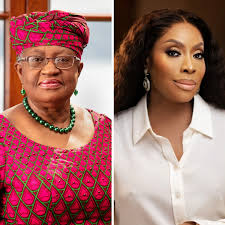

Two Nigerian women, Ngozi Okonjo-Iweala and Mo Abudu, have been named among Forbes’ 2025 World’s 100 Most Powerful Women, a recognition of their growing influence in global trade and media. The list, published on Forbes’ website on Wednesday, celebrates women who hold significant leadership roles in business, politics, culture, and international affairs. Their inclusion not only highlights the rising prominence of Nigerian women on the global stage but also underscores Africa’s expanding footprint in world leadership and enterprise.
Okonjo-Iweala and Abudu appear alongside other influential global figures, including European Commission President Ursula von der Leyen (No. 1), European Central Bank President Christine Lagarde (No. 2), Japan’s first female prime minister Sanae Takaichi (No. 3), Mexico’s President Claudia Sheinbaum (No. 5), and Namibia’s Prime Minister Netumbo Nandi-Ndaitwah (No. 79). Forbes’ 2025 ranking reflects a broad spectrum of sectors, from technology and finance to media, entertainment, and politics, illustrating the increasingly diverse arenas in which women are shaping global influence.
Ngozi Okonjo-Iweala, ranked 92nd on the list, is the current Director-General of the World Trade Organisation (WTO), a position she assumed in March 2021, making her both the first woman and the first African to lead the global trade body. Described by Forbes as “an economist and international development professional” with over 30 years of experience spanning Asia, Africa, Europe, Latin America, and North America, Okonjo-Iweala is celebrated for her commitment to leveraging trade as a tool to promote sustainable development and lift developing nations out of poverty. She previously served two terms as Nigeria’s Finance Minister from 2003 to 2006 and 2011 to 2015, and briefly acted as Foreign Minister in 2006. Beyond government service, she chaired the board of Gavi, the Vaccine Alliance, which has successfully immunised over 760 million children worldwide. Okonjo-Iweala holds a bachelor’s degree from Harvard University and a doctorate from the Massachusetts Institute of Technology and is widely respected for combining economic acumen with visionary global leadership.
Mo Abudu, ranked 98th, is a media entrepreneur, philanthropist, and founder of EbonyLife Media, a leading African media company. Since launching EbonyLife TV in 2006, Abudu has expanded her network to more than 49 countries, including the United Kingdom and the Caribbean. Forbes notes that she played a pivotal role in securing major partnerships with global entertainment giants such as Sony Pictures Television, AMC Networks, and Netflix, making EbonyLife the first African media company to sign a multi-title film and television agreement with the streaming platform. In November 2025, EbonyLife launched a new digital platform, EbonyLife ON Plus, available on Google Play and the Apple App Store, further extending its reach to a global audience. Born in London and raised partly in Nigeria, Abudu is celebrated for her ability to bridge African storytelling with international media standards, establishing her as one of the most influential women in global media today.
This year’s Forbes list also underscores the rising influence of women in technology and artificial intelligence. Notable figures include Lisa Su, CEO of AMD (No. 10); Ruth Porat, President and Chief Investment Officer at Alphabet (No. 12); Colette Kress of Nvidia (No. 37); Susan Li of Meta (No. 41); and Amy Hood of Microsoft (No. 16). Self-made billionaires and pioneers in AI and tech also feature prominently, including Daniela Amodei, co-founder of Anthropic, and Sarah Friar, CFO of OpenAI, highlighting the expanding impact of women in cutting-edge industries.
In addition to politics and technology, women in entertainment and culture continue to command global attention. Kim Kardashian, ranked 71st, earned recognition for her expansion of Skims into a $5 billion brand and for launching NikeSKIMS with Nike. Forbes also acknowledged the women behind Netflix’s KPop phenomenon Demon Hunters, noting their enormous cross-generational and international fanbase, demonstrating the growing influence of female leaders in shaping cultural trends worldwide.
The inclusion of Okonjo-Iweala and Abudu not only celebrates individual achievements but also highlights the broader influence of Nigerian women on the global stage. Okonjo-Iweala’s leadership at the WTO places Africa at the center of international trade negotiations, offering new perspectives on economic development, global supply chains, and equitable trade policies. Her work resonates across continents, reflecting her belief in the transformative power of trade to address inequality and promote sustainable growth.
Similarly, Abudu’s achievements in media underscore the potential of African storytelling to engage global audiences. By building strategic partnerships and embracing digital platforms, she has demonstrated how African creatives can compete on the world stage, shaping narratives and providing representation for African culture and perspectives in mainstream media. Her efforts have created opportunities for African talent and set benchmarks for entrepreneurial leadership in the continent’s media and entertainment sectors.
Forbes’ 2025 World’s Most Powerful Women list demonstrates a growing recognition of women’s diverse contributions to global leadership. From economics and trade to media, technology, and culture, the list reflects how women like Okonjo-Iweala and Abudu are redefining leadership roles, influencing policy, driving innovation, and inspiring future generations of female leaders.
Their inclusion also serves as an inspiration for women across Africa and the developing world, emphasizing that with vision, resilience, and leadership, women can break barriers, shape global discourse, and leave lasting legacies. As Nigerian representation grows on such international platforms, it not only celebrates individual accomplishments but also affirms Africa’s expanding influence in global decision-making, media, and commerce.