

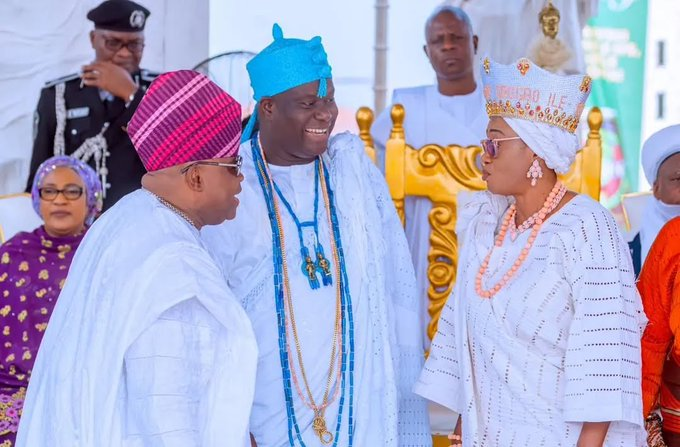

Nigeria’s cultural and political circles have been abuzz following a viral incident involving the First Lady, Senator Oluremi Tinubu, and Osun State Governor, Ademola Adeleke, during the 10th coronation anniversary of the Ooni of Ife, Oba Adeyeye Enitan Ogunwusi Ojaja II. The colourful celebration, held in Ile-Ife, drew top dignitaries from across the country and beyond, reflecting the Ooni’s influence as a custodian of Yoruba tradition. The event also marked a significant moment for the First Lady, who received the traditional title of Yeye Asiwaju Gbogbo Ile Oodua, a recognition of her perceived leadership, advocacy, and contributions to national development. However, the grandeur of the ceremony was partly overshadowed when a moment on stage sparked nationwide debate.
Governor Adeleke, known for his lively personality and spontaneous dance and music displays at public events, stepped forward to address the gathering. Before beginning his formal speech, he launched into a brief chant that drew laughter and applause from segments of the audience who are familiar with his charming, unconventional style.
But as the governor continued, the First Lady, who had only moments earlier received her chieftaincy honour, approached him gently, gestured toward the microphone, and whispered something believed to be a prompt for him to proceed with his formal remarks. The interaction lasted only seconds, but the moment captured on video quickly circulated across social media, where interpretations varied widely.
Many Nigerians online criticized the First Lady’s intervention, interpreting it as an unnecessary interruption and a sign of disrespect toward an elected governor. Among the critics was Akintunde Bello, Senior Special Assistant to Governor Adeleke on the Bureau of Social Services, who publicly argued that Senator Tinubu’s action was inappropriate. Bello insisted that the First Lady should be cautioned, saying her gesture could be viewed as undermining the authority of the Osun State governor, especially on an occasion where he represented his state in an official capacity. His comments added fuel to an already charged online conversation, driving further debate about respect, protocol, and political hierarchy.
Media mogul and political commentator Dele Momodu also weighed in, delivering one of the strongest condemnations yet. In a post on his Instagram handle, Momodu described the First Lady’s action as bullying, stating she “openly disgraced and embarrassed” Governor Adeleke before a global audience. He stressed that Mrs. Tinubu is not an elected government official and therefore has no constitutional role that empowers her to intervene in such a manner.
Momodu argued that the First Lady’s conduct was repugnant and unacceptable, particularly in the presence of the governor’s wife and other dignitaries. His remarks resonated deeply across social media, prompting discussions about power dynamics, respect for elected office, and the boundaries of influence wielded by spouses of political leaders.
But not all responses leaned toward criticism. Several voices came to the defence of the First Lady, insisting that the moment was being blown out of proportion and misinterpreted by political opponents. Dayo Fashola, an aide to former Osun State Governor Adegboyega Oyetola, described the exchange as entirely lighthearted.
Writing on Facebook, she explained that the First Lady simply encouraged the governor to move quickly through his remarks because many dignitaries needed to travel back before nightfall, when helicopter visibility is low. According to Fashola, the gesture was not a sign of disrespect but a practical reminder to help the event flow smoothly. She emphasized that Senator Tinubu had earlier sought permission to shorten her own speech for the same reason.
Some online supporters echoed similar sentiments. Facebook user Oyetunji Ayoade defended the First Lady’s action, noting that her standing up personally to communicate with the governor was, in his view, a sign of respect rather than condescension. He argued that if the First Lady had wanted to undermine Adeleke, she would not have walked forward herself; instead, her approach suggested a courteous, direct gesture. Ayoade insisted that the criticisms were largely fueled by political bias rather than an objective interpretation of what transpired. His comments gained traction among users who believed that the controversy was exaggerated.
Still, strong reactions persisted from other corners of social media. On X (formerly Twitter), Hon. Rilwan, an outspoken commentator, denounced Senator Tinubu’s action, claiming it was an attempt to “undermine the power of a legitimate government” in front of distinguished guests. His post, shared widely, represented the sentiment of those who argued that even subtle political gestures carry symbolic weight—especially on a culturally and politically significant stage like the Ooni’s palace. These opposing interpretations reflected the deeply polarized environment of Nigerian social media, where political affiliations frequently influence public reactions to national events.
Beyond the controversy, the Ooni’s 10th coronation anniversary was a landmark celebration of Yoruba culture, leadership, and unity. Traditional rulers, governors, national legislators, and cultural ambassadors from across Nigeria attended the ceremony, which showcased music, dance, ancestral rituals, and symbolic rites associated with the Ile-Ife monarchy.
The Ooni used the occasion to reflect on his decade-long reign, emphasizing peace, development, and the strengthening of Yoruba identity worldwide. His palace, adorned in regal colours, became a gathering place for a blend of tradition and modernity although the episode involving the First Lady and Governor Adeleke quickly became the most discussed moment of the day.
Amid the debates, some analysts highlighted that public scrutiny of political leaders and their families has intensified in recent years, especially in the age of viral videos. What might once have been a minor interaction now easily becomes national conversation. They noted that both sides of the debate raise valid questions: one about respecting democratic offices and protocol, and the other about reading human interactions with nuance rather than political suspicion. This incident, they argued, offers insight into Nigeria’s evolving political culture where public expectations, sensitivity to hierarchy, and social media dynamics all intersect.
While critics accuse Senator Oluremi Tinubu of overstepping her boundaries and embarrassing Governor Adeleke, supporters maintain that her intervention was harmless and pragmatic. The debate continues to spread across digital platforms, illustrating how quickly narratives can shift in Nigeria’s vibrant public sphere.
Yet beyond the controversy, the Ooni’s milestone celebration stood as a testament to cultural heritage, unity, and the enduring prestige of the Ile-Ife throne. As the conversation evolves, Nigerians remain split some furious, others unfazed but all united in closely watching the interplay between culture, politics, and public perception.