

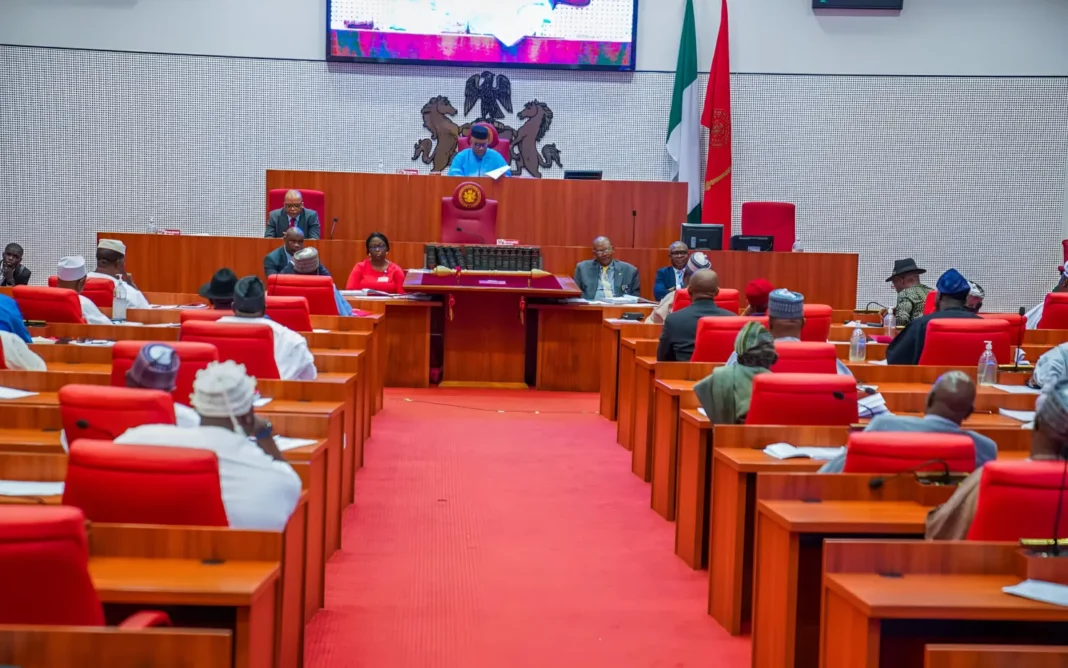

In a radical legislative response to the nation’s escalating security crisis, the Nigerian National Senate passed a resolution on Wednesday, 26th November, to designate kidnapping as a form of terrorism, mandating the death penalty for convicted offenders, while stripping judges of any discretion to impose lesser sentences.
The historic decision, emerging from a tense and rowdy session, signified the underlying reason for the government to arrest the growing plague of insecurity that has paralyzed several communities, spreading widely across the country.
The move was directly triggered by the recent attack on the Christ Apostolic Church in Eruku, Kwara State, where gunmen killed two worshippers and abducted 38 others, an incident lawmakers cited as evidence of the southward spread of insurgent cells.
The debate was set in motion by Senator Yisa Ashiru from Kwara South, raising the alarming state of insecurity in Nigeria. Meanwhile, other Senators also reported that relentless school abductions have forced the closure of several schools in different local governments across Kebbi and Niger states, parts of Kwara, and all 47 Federal Unity Colleges nationwide.
“The prevalence of this menace has made it a terrorist activity, and for that reason, capital punishment must apply.” The lawmakers contended that the profit-driven networks of kidnappers now operate as full-fledged terrorist organizations.
Senator Issa Jibrin from Kogi East highlighted a critical manpower shortage, noting that Nigeria’s entire security personnel “do not total one million,” compared to Egypt’s 1.5 million. He called for urgent equipment upgrades and the creation of a reserve force.
A fierce exchange on accountability saw Senator Enyinnaya Abaribe push back against deflecting blame to past administrations. “Who asked [the troops] to withdraw? Nobody knows. If I were the Commander-in-Chief, I would demand answers,” he stated, referencing reports of a military pullback before a recent attack in Kebbi.
His sentiment was echoed by Senator Adams Oshiomhole, who demanded, “Who ordered the military to withdraw? That person should be tried for terrorism.” The Senate formally adopted this call for an investigation.
In a moment of rare self-critique, Senate Leader Opeyemi Bamidele turned the spotlight on the legislature itself. “If we are calling on the President to rejig the security architecture, we must also look into our own arrangement. I am not impressed with our Committee on Security and Intelligence,” he declared.
Acting on this, the Senate immediately dissolved its Committees on National Security and Intelligence and the Air Force, ordering all security-related committees to submit oversight reports within one week.
Further measures adopted include a directive to the Federal Ministry of Works to reconstruct dilapidated roads used as escape routes by criminals, a plan to federally support and strengthen vigilante groups, and a review of firearms laws to allow for the controlled arming of responsible citizens.
The resolution now urges President Bola Tinubu to “further rejig the nation’s security architecture,” with clarifications that the focus is on improving coordination, technology, and intelligence. The move to make the death penalty mandatory is expected to face significant legal and human rights challenges, marking a pivotal moment in Nigeria’s long-running battle against endemic insecurity.