

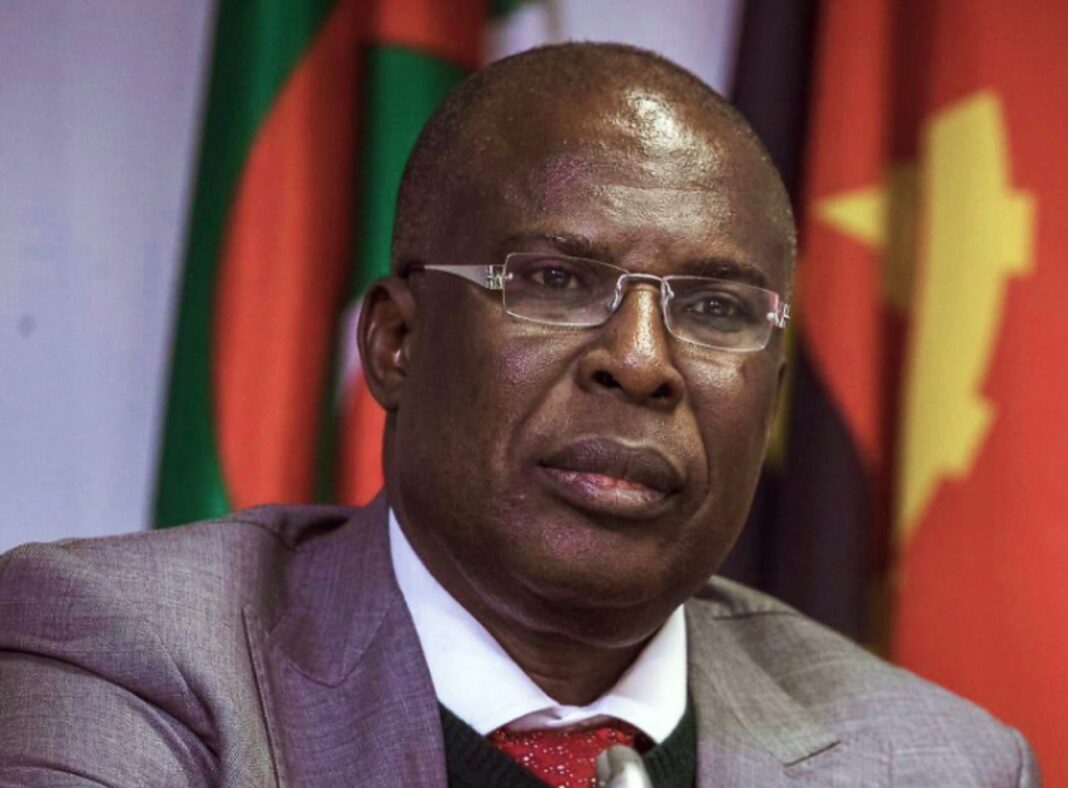

The Economic and Financial Crimes Commission has declared former Minister of State for Petroleum Resources and former Governor of Bayelsa State, Timipre Sylva, wanted over alleged conspiracy and dishonest conversion of funds totaling fourteen million eight hundred and fifty-nine thousand two hundred and fifty-seven dollars ($14,859,257). The EFCC made this known through an official public notice released on Monday, November 10, 2025, signed by its Head of Media and Publicity, Dele Oyewale.
According to the agency, the alleged funds were part of the investment made by the Nigerian Content Development and Monitoring Board into Atlantic International Refinery and Petrochemical Limited for the construction of a refinery project. The Commission stated that the wanted declaration followed a warrant issued by the Federal High Court sitting in Lagos on November 6, 2025, authorizing law enforcement agencies to arrest Sylva and bring him before the court to answer to the charges preferred against him. The notice carried his photograph, full name, and place of origin, and called on members of the public with any useful information regarding his whereabouts to contact any EFCC office across the country or the nearest police station. It further listed the Commission’s offices in Abuja, Lagos, Benin, Uyo, Sokoto, Port Harcourt, Kano, Gombe, Ilorin, Enugu, Makurdi, Maiduguri, Ibadan, and Kaduna as contact points.
Born in July 1964, Sylva first came to political prominence in Bayelsa State, where he served in various capacities before becoming governor in 2007 under the platform of the Peoples Democratic Party. His tenure as governor lasted until 2012 after a series of political and legal challenges. As governor, he presided over one of Nigeria’s most oil-rich states during a period marked by rising tensions in the Niger Delta and expanding federal intervention through the Amnesty Programme. His administration was later scrutinized for alleged financial mismanagement, although no conviction was ever recorded against him during that period. Following his time as governor, Sylva remained an influential political figure, maintaining close ties with key national politicians and later aligning himself with the All Progressives Congress.
In 2019, he was appointed by President Muhammadu Buhari as Minister of State for Petroleum Resources, a role in which he was expected to oversee critical reforms in Nigeria’s oil and gas sector. His tenure coincided with the final stages of the Petroleum Industry Bill, which was eventually signed into law in 2021 as the Petroleum Industry Act. During that time, he frequently represented Nigeria at international oil summits and meetings of the Organization of Petroleum Exporting Countries. His ministry worked alongside the Nigerian National Petroleum Company Limited, the Department of Petroleum Resources, and the Nigerian Content Development and Monitoring Board, with the latter agency at the center of the current allegations. The EFCC wanted notice link the $14.8 million to funds allegedly injected by the NCDMB into a refinery project undertaken by Atlantic International Refinery and Petrochemical Limited. The Commission alleges that those funds were dishonestly converted in violation of existing financial regulations.
The story first began to gather attention days before the EFCC’s formal declaration, when reports surfaced that security operatives had conducted a raid on Sylva’s residence in Abuja’s Maitama district and his Bayelsa home. The operation was reportedly linked to an ongoing investigation, though details were initially unclear. Some accounts mentioned that a special military team had participated in the raid under a separate investigation concerning alleged coup plots, but those reports were never officially confirmed. Sylva’s aides at the time claimed that he was outside the country on medical and professional engagements when the raids occurred. The former minister did not make any public appearance after those incidents, and his whereabouts have since remained unknown. The EFCC’s latest move therefore, formalizes what had been a developing situation over the past week, officially placing him on the wanted list for alleged financial crimes.
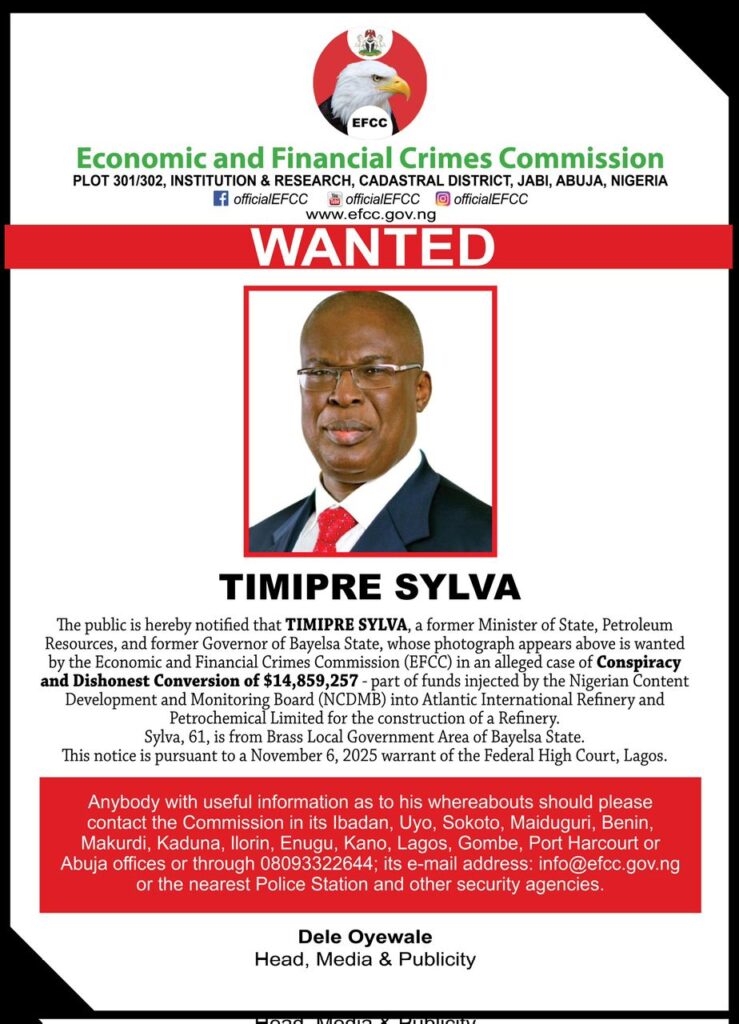
The EFCC, in its public communication, emphasized that anyone with information as to his location should come forward, stressing the importance of public cooperation in apprehending the suspect. The Commission did not immediately disclose the identities of other individuals who might be involved in the case, although sources within the oil and gas sector have suggested that investigations into the management of funds tied to the refinery project have been ongoing for some time. It is believed that the project was initiated under a partnership intended to promote indigenous participation in the downstream sector. The refinery was one of several ventures championed by the NCDMB to advance local capacity building, but questions later arose concerning the use of allocated funds and the progress of construction.
This is not the first time Sylva’s name has surfaced in the context of corruption allegations. During his tenure as governor, the EFCC had once filed charges against him involving the alleged diversion of over six billion naira in state funds. Those charges were later struck out after several years of legal back and forth. Despite those controversies, Sylva maintained political relevance, playing a central role in the 2019 and 2023 general elections as a senior figure within the ruling party. He even contested the Bayelsa State governorship election again in 2023 but lost to the incumbent governor, Douye Diri. Following the election, he gradually retreated from public appearances but continued to feature occasionally at petroleum industry events until early 2024.
As of Monday evening, no arrest had been confirmed, and Sylva’s legal representatives had yet to issue an official statement. Law enforcement sources confirmed that surveillance and tracking measures were being coordinated across states where he is believed to have strong personal or business interests.
The implication of the case reaches beyond the individual accused. The funds in question were tied to an investment meant to strengthen Nigeria’s domestic refining capacity, an area of significant economic interest as the country seeks to reduce dependence on imported petroleum products. The revelation that part of such funds may have been misused underscores ongoing challenges in accountability within public-private ventures in the petroleum industry.
For now, Timipre Sylva remains at large, and the EFCC has called on the public and security agencies nationwide to remain alert. His last known public appearance was in mid-2024 at an energy conference in Abuja, after which he withdrew from public view. Whether he will turn himself in or continue to evade arrest remains uncertain. The coming days are expected to reveal whether the former minister will face prosecution or seek to challenge the allegations from outside the country. The Commission, meanwhile, maintains that it is committed to recovering public funds and ensuring accountability regardless of status or office previously held.
As investigations progress, attention will also turn to the operations of the Nigerian Content Development and Monitoring Board, which has been central to promoting local participation in the oil and gas industry. Questions are likely to arise about how the funds were approved, monitored, and disbursed, as well as whether internal controls within the agency were sufficiently robust. The EFCC’s pursuit of this case therefore carries implications not only for Timipre Sylva but for the broader framework of transparency in Nigeria’s petroleum governance.
Samuel Aina