

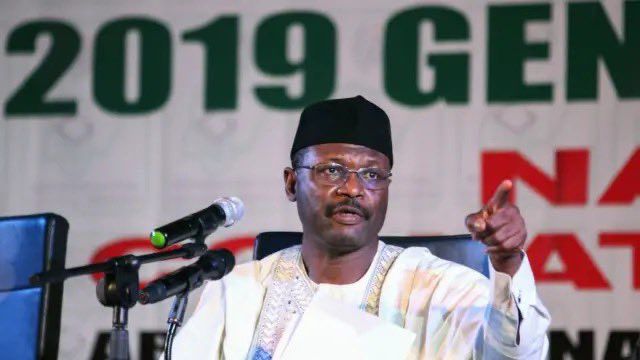

Prof. Mahmood Yakubu, the Chairman of the Independent National Electoral Commission (INEC), has stepped down about a month ahead of the official end of his tenure and handed over leadership to an acting chair, identified as May Agbamuche-Mbu.
The term of Prof. Yakubu was originally slated to expire in December 2025. He first took office in 2015, appointed by then-President Muhammadu Buhari, and was later confirmed for a second term beginning in late 2020. Having served two full terms, Yakubu’s departure ahead of schedule marks a rare break in continuity at the electoral umpire.
The name “May Agbamuche-Mbu” has come up in multiple accounts as the acting chair. Though official confirmation from INEC is still awaited at the time of writing, party officials, insiders in the commission, and media reports appear aligned on that designation. The early handover is seen by some as an effort by the presidency to assert influence over the commission’s leadership ahead of the 2027 general elections, while others interpret it as a transitional arrangement intended to facilitate a smoother handover process.
On the political front, the timing is significant. Yakubu’s last months in office coincided with rising polarization, pressure over electoral credibility, and debates about reforms. Some observers suggest that the sudden shift may disrupt preparations for upcoming polls, especially among political parties who were engaging with INEC’s consultative processes. The move could reset alliances and prompt jockeying among party operatives for influence over the interim leadership.
Critics are already voicing concern. Civil society groups and opposition elements warn that such a switch, if not handled transparently, risks further eroding trust in INEC’s neutrality. They argue that appointing an acting chair without public consultation or clear criteria may strengthen perceptions that electoral institutions are vulnerable to executive interference. These actors are likely to demand clarity on how the selection was made, whether the Council of State or relevant statutory bodies were consulted, and what the roadmap is for filling the position permanently.
Supporters of the move claim it is within the authority of the president and necessary to prepare for the next phase of leadership. They suggest that an acting chair can provide continuity while a full replacement is proposed, vetted, and confirmed by the Senate. In that view, the transition may forestall a leadership vacuum and prevent delays in INEC’s schedule.
Already, discussion is swirling around possible permanent successors. Earlier reports flagged Prof. Joash Ojo Amupitan as a likely contender, noting his legal credentials, academic reputation and political networks. Whether he will be formally nominated remains to be seen.
In operational terms, the change in INEC leadership may slow or pause certain initiatives, especially those requiring senior approval or signature by the chair. Political parties, civil society organisations, and electoral stakeholders will be watching closely how the acting chair handles consultations, internal governance, and upcoming deadlines. Any perceived favoritism or delay could magnify concerns about impartiality.
Mahmood Yakubu’s decade at the helm of INEC is marked first and foremost by a push to modernize how Nigeria votes and how results are managed. Under his leadership, the commission rolled out the Bimodal Voter Accreditation System (BVAS) to reduce multiple voting and improve the integrity of accreditation at polling units. INEC also introduced electronic transmission of results through the IReV portal and related result management tools to speed up reporting and make outcomes more auditable. These are widely regarded as commendable improvements, although many remain dissatisfied with their implementation.
The commission under Yakubu ran multiple national and off-cycle elections, including the high-profile 2019 and 2023 general polls and a string of governorship contests. The body also expanded Continuous Voter Registration efforts, recording millions of new registrants in waves of CVR activity.
Public reaction was mixed and at times febrile. Many Nigerians welcomed the technological innovations as steps toward transparency and reduced result-tinkering. Civil society and election observers credited BVAS and electronic result portals for narrowing opportunities for manipulation when they functioned well. At the same time a vocal segment of the public, opposition parties and some commentators argued that delays, technical glitches and perceived lapses eroded confidence in INEC. That criticism intensified after tightly contested contests and tribunal rulings that overturned certain outcomes.
Yakubu’s INEC leaves a record of institutional reform and modernisation alongside unresolved questions about trust and implementation. The technologies and practices he institutionalized have the potential to strengthen future polls, but converting potential into consistent public confidence will be the urgent task for whoever follows him.

His current replacement, May Agbamuche-Mbu, however, is a legal practitioner with more than thirty years of experience in both public and private sectors. She has been a National Commissioner with the Independent National Electoral Commission (INEC) until her recent appointment as acting INEC Chairman today. She hails from Delta State, though she was born in Kano. She attended St. Louis Secondary School in Kano. She earned her LL.B. in Law from the University of Ife (now Obafemi Awolowo University) in 1984. She was called to the Nigerian Bar in 1985. She furthered her studies in London. She qualified as a Solicitor of the Supreme Court of England and Wales by attending the College of Law, London. She later earned an LL.M. specialising in Commercial and Corporate Law from Queen Mary and Westfield College, London. She also completed postgraduate programmes in International Dispute Resolution and International Business Law. She has expertise in Alternative Dispute Resolution and is a member of the Chartered Institute of Arbitrators, UK-Nigeria branch. At one time, she served as Secretary to that institute.
For ordinary Nigerians, the immediate concern is whether the shift will affect preparation, transparency, and fairness in the conduct of future elections. Will party registration, voter outreach, technology deployment, logistics planning and consultant assessments continue smoothly? Will the acting chair inspire confidence among political parties and judges? The public’s expectations for accountability and credible elections remain high, and the change in leadership is likely to be evaluated harshly by many.
Samuel Aina