

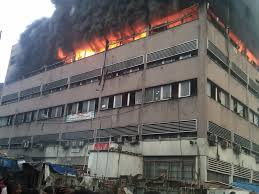

The Afriland Towers fire on Broad Street, Lagos Island, was a sudden and devastating blaze that gutted a six-storey commercial building on Tuesday, and by the following days investigators and emergency services had confirmed a rising death toll that reached ten. Initial reports described chaotic scenes as occupants scrambled to escape, with some people forced to jump from upper-floor windows to flee the flames; survivors and first responders painted a picture of panic, thick smoke and rapid fire spread that overwhelmed some escape routes.
Local fire authorities and hospital sources confirmed multiple fatalities and scores of injured victims being treated across Lagos hospitals, while tenants and neighbouring businesses reported extensive property damage and losses worth millions of naira.
Eyewitness accounts and reporting from the scene pointed to the fire’s speed and ferocity: employees who worked in the building, including staff of the Federal Inland Revenue Service (FIRS), United Capital Plc and the United Bank for Africa (UBA), described how the blaze appeared to originate in lower levels and then raced upward through the structure, cutting off stairwells and exits.
Some survivors told journalists that emergency responses felt slow and inadequate, with criticism levelled at initial arrival times and the availability of equipment capable of tackling a high-rise inferno of that scale. These narratives have fed immediate public scrutiny of Lagos’s emergency readiness for commercial high-rise fires and prompted officials to promise rigorous investigations.
Official agencies quickly moved to verify the human cost and the sequence of events. The Lagos State Fire and Rescue Service (LSFRS) issued regular briefings that the confirmed casualties included both men and women, and that their investigations initially identified the building’s inverter room in the basement as the likely ignition point — though fire authorities cautioned that a full forensic probe would be required to confirm the precise cause and contributing factors.
The Federal Fire Service also announced it would join the inquiry, and both state and federal agencies signalled intent to coordinate a multi-agency probe to examine building compliance, electrical installations, emergency-exit readiness and the role, if any, of alternative power systems.
The human toll was concentrated among employees of major institutional tenants: FIRS and United Capital confirmed that they had lost staff in the blaze, with FIRS acknowledging the deaths of senior personnel and United Capital reporting multiple staff fatalities. Corporate statements from affected firms expressed sorrow and pledged support to bereaved families, while management teams described the shock of losing experienced colleagues and the operational disruption the fire would cause.
These corporate confirmations shifted the narrative from a generic building fire to a tragedy with significant implications for federal revenue staff and the financial services sector, amplifying calls for accountability and compensation for affected families.
President Bola Ahmed Tinubu publicly extended condolences to the families of the victims, the Federal Inland Revenue Service, United Capital and UBA, and stressed federal attention to the emergency response and follow-up measures. The Office of the President released a statement of sympathy and said the Federal Government was working with Lagos State to ensure a thorough investigation and to take steps that would prevent similar tragedies in the future.
Lagos State Governor Babajide Sanwo-Olu echoed the president’s sentiments, describing the incident as a shocking and unfortunate loss and commiserating with the management and staff of the affected organisations while wishing the injured a speedy recovery. These high-level messages were matched by statements from the Federal Fire Service and other public institutions promising accountability and remedial action.
Emergency and rescue crews described the salvage and recovery phase as difficult and emotionally gruelling. Firefighters and medical teams worked into the night to recover bodies, treat burn and smoke-inhalation victims, and secure the site. Photographs and video from the scene showed charred interiors and blackened debris, with rubble being cleared as investigators documented scene evidence.
Officials from the Lagos State Emergency Management Agency (LASEMA) and other first-response units were reported to be coordinating patient transfers and family-notification processes, while psychosocial support teams were mobilised to counsel survivors and bereaved relatives. The intensity of the recovery operation highlighted both the human cost and the technical challenge of responding to fires in older or densely occupied commercial blocks.
Preliminary forensic leads focussed attention on electrical infrastructure and backup power systems, with multiple outlets reporting that the fire likely began in an inverter room in the basement — a location commonly used to house generators, inverters and battery banks that supply power during outages.
Fire-safety experts quoted in the media warned that poorly installed or badly maintained inverters and batteries can spark fires, and that inadequate ventilation or lack of proper firebreaks within utility rooms can allow a small ignition to escalate quickly. Such technical commentary has spurred urgent calls for audits of similar installations across Lagos commercial buildings, with industry bodies and safety professionals urging stricter enforcement of installation standards and regular inspection regimes.
Public reaction was immediate and amplifying: social media feeds filled with eyewitness videos, condolence messages, and demands for answers. Families of victims and colleagues of those who perished shared memories and photos, while activists and safety advocates urged that the tragedy be a turning point for fire-safety enforcement.
Some commentators highlighted a pattern of prior incidents and alleged regulatory neglect, arguing that repeated tragedies expose systemic weaknesses in building certification, fire-escape enforcement and enforcement of safety regulations. In response to public pressure, both Lagos State and federal agencies pledged transparency in the investigation and promised to publish findings when available.
The unfolding investigation has focused not only on the immediate technical cause but also on organizational responsibilities: whether building owners complied with statutory regulations, whether fire alarms and sprinkler systems (if installed) were functioning, if emergency drills were carried out, and whether tenants were informed about escape routes.
Local regulators signalled intent to review Afriland Towers’ compliance certificates and maintenance logs, and the Federal Fire Service announced a task force to audit high-risk commercial properties. Industry groups called on insurers and corporate tenants to push for higher safety standards and to ensure that critical infrastructure — particularly backup power systems — meet up-to-date fire-safety norms.
Legal and policy responses have already been signalled. Governors’ and federal offices indicated they would not only investigate but also consider tougher enforcement, including penalties for non-compliance and possible demolition of unsafe structures. The Federal Fire Service’s announcement of a task force and the Lagos government’s vow to probe the matter were intended to reassure the public that systemic answers — not only scene-level blame assignment — would be sought.
Safety professionals recommended a package of measures: mandatory retro-fitting of sprinkler systems where absent, routine certification of electrical and inverter installations, clearer corporate evacuation policies and mandatory emergency drills for high-occupancy commercial blocks.
Community and national leaders added condolence voices and calls for action. Beyond President Tinubu and Governor Sanwo-Olu, religious leaders, civil-society organisations and sectoral groups issued statements mourning the dead and urging reform. Several commentators framed the incident as a national wake-up call about urban safety in Nigeria’s megacities — a reminder that as commercial activity intensifies, infrastructure and regulatory regimes must keep pace.
Looking forward, investigators have said that conclusive determinations will hinge on forensic analysis of electrical components, maintenance records and CCTV footage, together with interviews of building managers and tenants. The multi-agency probe — involving the Lagos State Fire Service, the Federal Fire Service, building regulators and law-enforcement partners — aims to produce a public report outlining causation and actionable recommendations.
Meanwhile, families await compensation talks and clearer timelines for how organisations and insurers will respond, and workers in the area face questions about when the damaged property will be secured or cleared for reconstruction.
The Afriland Towers fire has already prompted immediate policy ripples: regulators signalled inspections of similar commercial buildings, and safety advocates expect new urgency behind enforcement campaigns. If authorities follow through, we could see a wave of audits, retro-fits and, possibly, legislative tightening around backup power installations and high-rise fire safety certifications.