

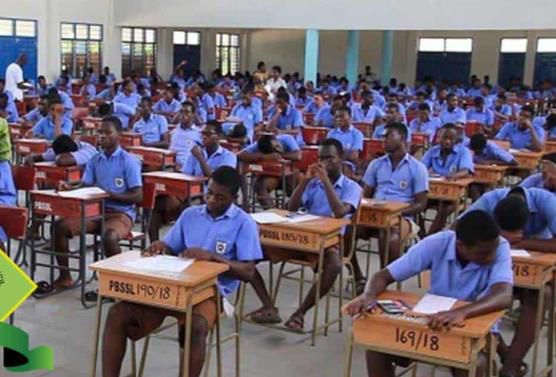

The National Examinations Council (NECO) has released the 2024 Senior Secondary Certificate Examination (SSCE) results showing that 60.55 percent of the 1,367,736 students who sat the exam secured five credits including English Language and Mathematics yesterday in Minna. Professor Dantani Ibrahim Wushishi, Registrar and Chief Executive Officer of NECO, described the result as encouraging although it also reveals that past challenges persist.
In 2023 the pass rate for five credits including English and Mathematics was slightly higher at 61.60 percent, meaning this year’s performance marks a mild drop. However, Wushishi said that the drop should not mask other positive trends. There was a sharp reduction in examination malpractice cases, from 12,030 in 2023 to 8,437 this year reflecting a 30.1 percent decrease.
NECO also reported that 83.90 percent of candidates achieved five credits or more in any subjects irrespective of performance in English or Mathematics compared to 84.68 percent in 2023. Of the 1,376,423 students registered, 1,367,736 actually sat for the exams. Those who registered but did not sit were slightly higher than last year.
The history of NECO results over the past decade shows that achieving over 60 percent in core subjects has been both milestone and mirage. In years past many candidates failed to meet five credits including English and Mathematics. Factors such as examination malpractice, poor school infrastructure, late release of exam schedules, lack of teacher motivation, and inadequate study materials have repeatedly been blamed for poor outcomes. In 2019 and 2020 the pass rates in core subjects dipped below 55 percent in some states. In 2021 and 2022 many candidates scored credits in non-core subjects but flunked essential ones like Mathematics and English which are required for admission to universities and many job qualifications. Community groups and education stakeholders have often called out this pattern as gate-keeping by failure. NECO itself has instituted reforms over time including stricter invigilation, deployment of technology, better training for supervisors, regulation of examiner recruitment and mandatory identity verification for candidates. Many analysts say these reforms have slowly improved integrity though not evenly across states.
Among states Abia, Imo and Ebonyi emerged as top performers with highest proportion of students meeting the five credits including the core subjects. In contrast Katsina, Kano, Jigawa, Zamfara and Borno recorded among the lowest. For example Katsina’s performance in core subject credits was significantly below the national average. These variations reflect long-standing regional disparities in school funding, teacher availability, insecurity, and access to learning resources.
Students with special needs were not left out of the report. A total of 2,267 candidates with various impairments participated in the 2024 SSCE. NECO’s statement placed them among those who wrote the exams showing inclusion remains part of the national plan though stakeholders say much more investment is needed for special education.
Registrar Wushishi widened the lens beyond numbers. He praised students, teachers and schools for rising despite the constraints. He noted that releasing the results 55 days after the last paper was written marked an improvement in timeliness. In previous years delays in marking, supervision, logistics and result publication have dragged into months, sometimes affecting students hoping to gain university admission.
Still concerns remain. While malpractice cases have dropped, there were still 40 schools implicated in mass cheating across 17 states. One school in Ekiti State is being recommended for de-recognition for repeated malpractices in core subjects. Twenty-one supervisors were flagged for negligence, aiding malpractices, or poor supervision in twelve states. Critics say these lapses undermine trust in results and hurt honest students.
Education experts argue that improvement must include better teacher training, stronger accountability mechanisms, more support for remote and northern-region schools and urgent tackling of power supply, Internet access and school infrastructure deficiencies. They believe that unless these structural gaps are closed the difference between states will widen and national averages may stagnate or even fall. For many students this year’s results bring relief and renewed hope. Achieving five credits with English and Mathematics opens doors to tertiary education, scholarships and stronger job prospects. Parents and guardians who invested time, money and effort saw returns. But the drop from last year signals that the journey forward remains fragile.
NECO’s 2024 SSCE results show that Nigerian students are capable of meeting and exceeding expectations when systems improve. The 60.55 percent pass rate in core subjects is not just a statistic. It is a reminder that progress is possible. Yet it is also a challenge to education officials to keep up reforms, enforce discipline, increase equity and ensure that good performance becomes the norm not exception. The next steps are clear tackle state disparities, root out malpractice completely and ensure every child in Nigeria has the chance to pass and succeed.
Samuel Aina