

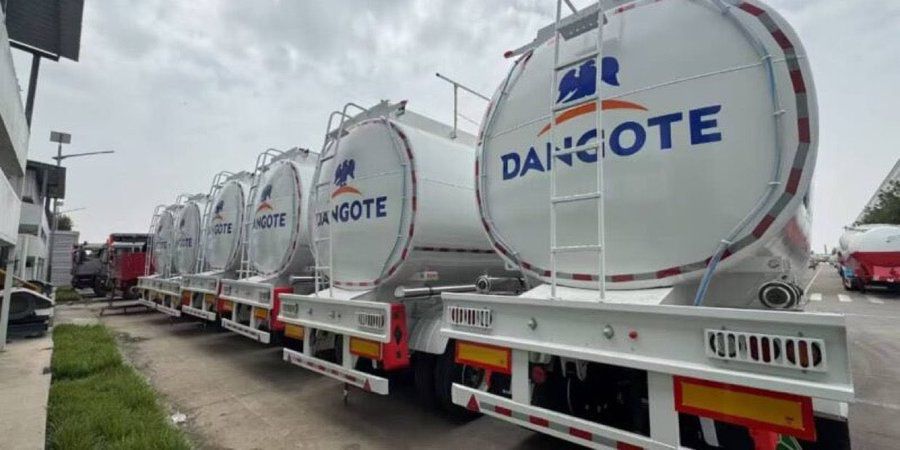

Today marks a landmark moment in Nigeria’s energy sector as Dangote Refinery begins free direct delivery of petrol to registered stations in at least eleven states across the country. The announcement comes after weeks of tension, disputes, and pressure from unions and marketers. Fuel station owners that register will now receive Premium Motor Spirit (PMS) deliveries at no logistical cost. Using a new fleet of compressed natural gas trucks, Dangote hopes to cut fuel distribution expenses and bring down pump prices, which have been a constant source of national frustration and political debate.
The journey to this point has been anything but smooth. For over a year, the refinery produced petrol, diesel, and jet fuel at full capacity, yet downstream distribution remained tangled in bureaucracy, nonfunctional pipelines, exploitation by middlemen, and union resistance. Although the refinery achieved its capacity of about 650,000 barrels per day, moving products to retail stations proved difficult. Distributors and independent marketers cited poor infrastructure, shortage of trucks, and high transport costs. Many stations closed down entirely, unable to sustain operations under such conditions.
To resolve this bottleneck, Dangote invested heavily in logistics. By mid-2025, the refinery ordered 4,000 compressed natural gas trucks, at a cost of nearly seven hundred and twenty billion naira. These trucks were designed to power a direct-supply model, taking fuel straight from the gantry to retailers and bypassing costly intermediaries. The plan was to begin in August, but labour disputes delayed full rollout until mid-September. Registration portals were then opened for marketers to enroll and benefit from the free delivery system.
Resistance came swiftly from unions. NUPENG, which represents petroleum tanker drivers, warned that free delivery threatened their members’ livelihoods. They alleged that Dangote was trying to sideline drivers in favour of a new trucking association. Strikes, protests, and ultimatums followed. After weeks of negotiations, a memorandum of understanding was signed. It guaranteed drivers protection from victimisation, preserved union rights, and promised greater transparency in the logistics rollout.
Marketers also voiced concerns. DAPPMAN and IPMAN argued that the “free delivery” scheme was tied to conditions that gave Dangote too much control. Marketers complained that they were required to lift a fixed portion of their allocations directly from the refinery using only Dangote’s trucks. For stations located in remote areas, they feared hidden costs and longer turnaround times. Some accused the refinery of exaggerating cost savings.
Dangote’s camp rejected these claims. They argued that centralising logistics would ensure efficiency, safety, and compliance with regulations. By using Dangote’s trucks, the refinery could prevent inflated charges by middlemen and guarantee that savings reached consumers. The company pointed out that many filling stations had already collapsed due to high costs, and that this model offered a chance to revive them and restore stability to supply chains.

From today, Lagos and the South-West will see petrol priced at ₦841 per litre, while Abuja, Delta, Rivers, Edo, and Kwara will receive it at ₦851. The gantry price has been pegged at ₦820 per litre. Station owners are urged to register for the programme in order to benefit from the new structure. As more trucks become operational, the scheme will expand across the federation.
The expected benefits are significant. Lower transport costs should reduce pump prices and ease inflation in other sectors, particularly agriculture and manufacturing, where fuel expenses drive up production. Commuters, small businesses, and households stand to gain the most.
Still, critics remain wary. Some economists warn that if Dangote gains too much control over distribution, competition could collapse. Free delivery, they say, may serve as a short-term lure before prices are adjusted. Labour unions also remain watchful, demanding guarantees that workers and drivers will not be sidelined.
The government has promised close monitoring. The Nigerian Midstream and Downstream Petroleum Regulatory Authority will oversee compliance with pricing rules and quality standards. Officials from the Ministry of Petroleum have pledged periodic reviews to ensure that savings reach consumers rather than being absorbed by middlemen or select marketers.
Today therefore represents more than the start of a delivery scheme. It is a test of whether Dangote can deliver real relief at the pump and prove that promises of reliable, affordable supply are achievable. Nigerians are weary of scarcity, long queues, and inconsistent pricing. Many now place their hopes in this initiative, which has the potential to reshape the downstream sector.
If it succeeds, it could mark the beginning of long-awaited reform. If it fails, critics will be vindicated, and Dangote’s project will join the long list of missed opportunities in Nigeria’s oil industry. For now, the country waits, watching closely, as the first trucks roll out with free deliveries that could either ease decades of fuel anxiety or deepen it further.
Samuel Aina